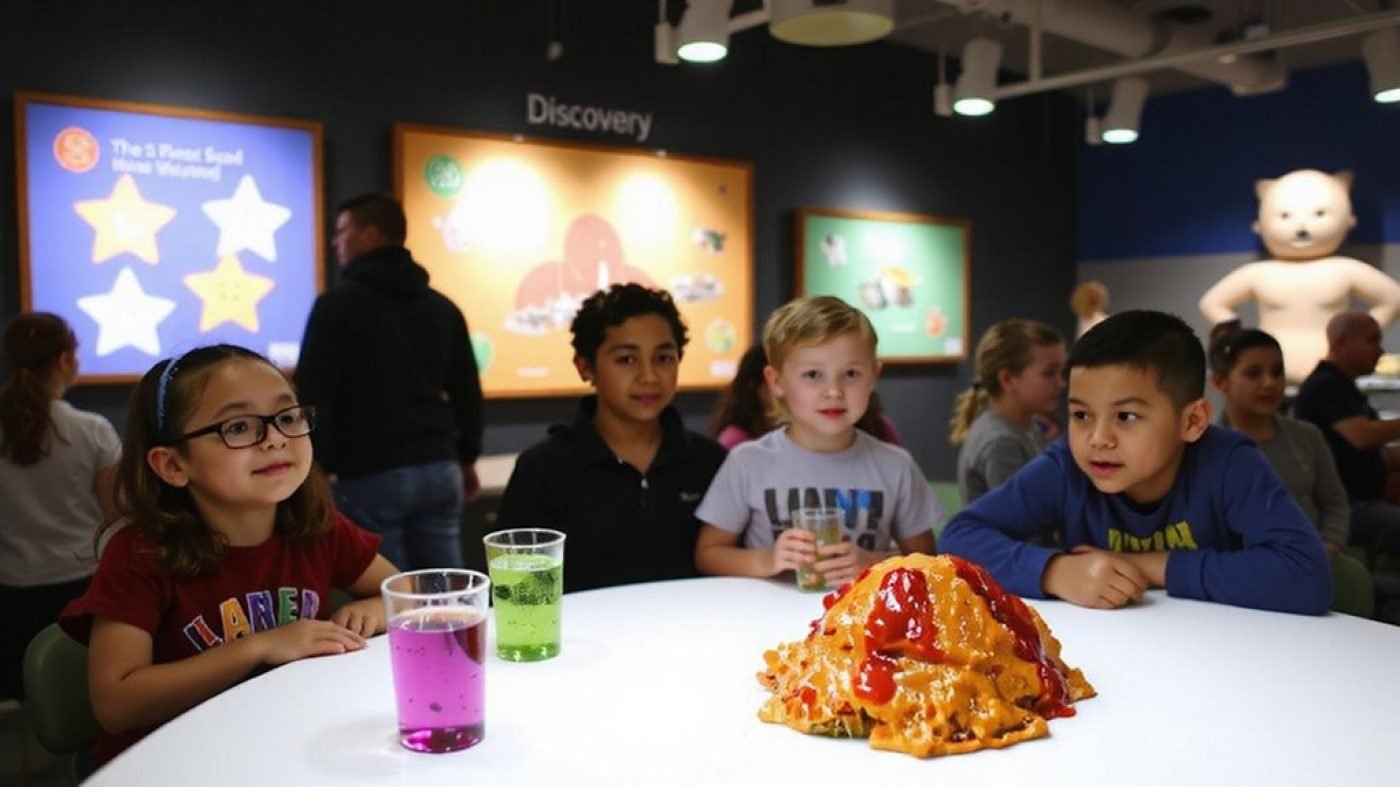

You’ll try hands-on experiments at Discovery Children’s Museum that make science feel like play. You’ll mix fizzing volcanoes, build simple circuits, and race ramps while facilitators guide your family. Each activity boosts curiosity, motor skills, and scientific vocabulary. Keep going to see simple follow-ups you can try at home and spark ongoing discovery.
Hands-On Chemistry Experiments for Little Scientists
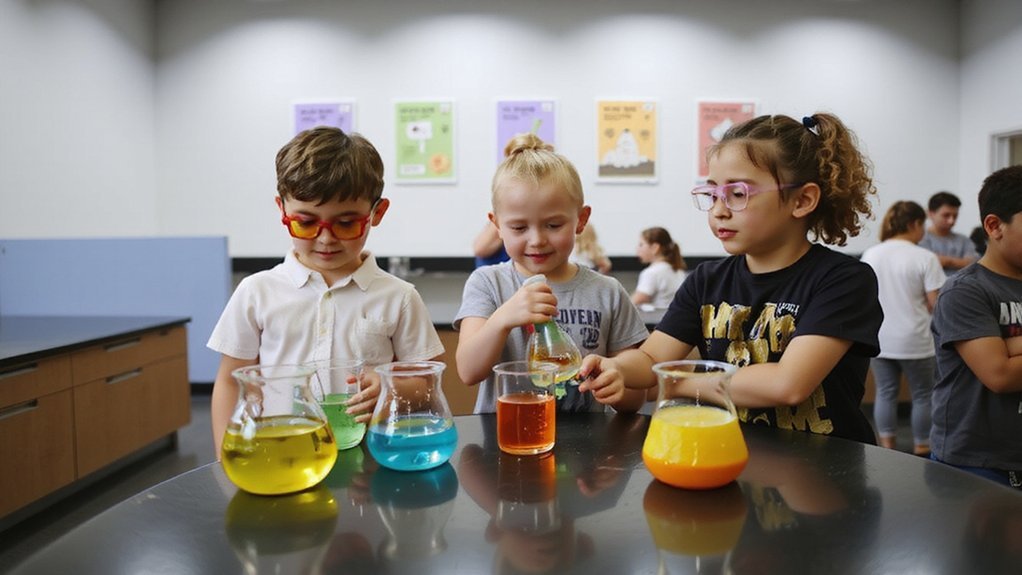
When you try simple chemistry experiments at home, you’ll watch everyday ingredients turn into exciting science — fizzing volcanoes, color-changing potions, and gooey polymers that teach you about reactions, acids and bases, and materials. You’ll mix baking soda and vinegar to see gas expand, make rainbow pH paper with red cabbage, and build non-Newtonian slime to feel how materials behave differently under stress. Each safe activity asks you to hypothesize, measure, and observe, teaching lab habits and creativity. Use clear steps, goggles, and supervision, and encourage kids to tweak variables—temperature, concentration, or timing—to innovate outcomes. These projects spark curiosity, demystify chemical concepts, and invite playful experimentation that inspires future inventors. You’ll share results, record data, and celebrate small discoveries to build confidence and teamwork.
Simple Physics Demonstrations: Motion and Forces
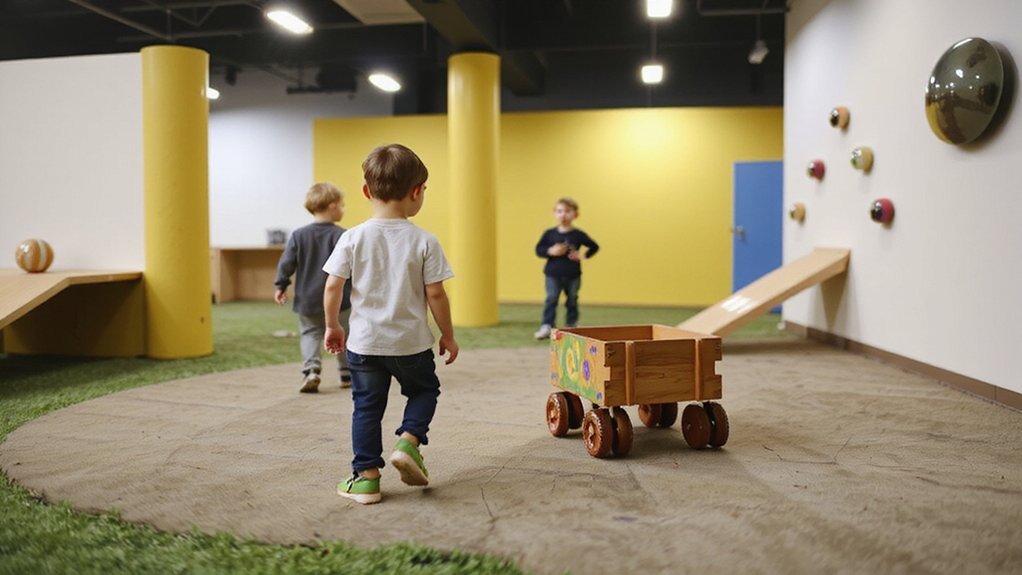
After exploring fizzing reactions and stretchy polymers, you’ll find physics is another playground for curious hands. You can roll marbles down ramps to see how angle changes speed, and time runs show acceleration. Try balloon rockets on a string to feel action and reaction—let go and watch thrust propel motion. Swing a simple pendulum to observe periodic motion and predict beats. Use toy cars and different surfaces to explore friction’s grip, and drop parachutes of various sizes to compare air resistance. Push on stationary objects to experience inertia, then add gentle pushes to study momentum transfer. These hands-on demos spark questions, invite tweaks, and encourage you to invent new ways to reveal motion and forces safely. You’ll discover surprising patterns and practical insights together.
Engineering Challenges: Build and Test
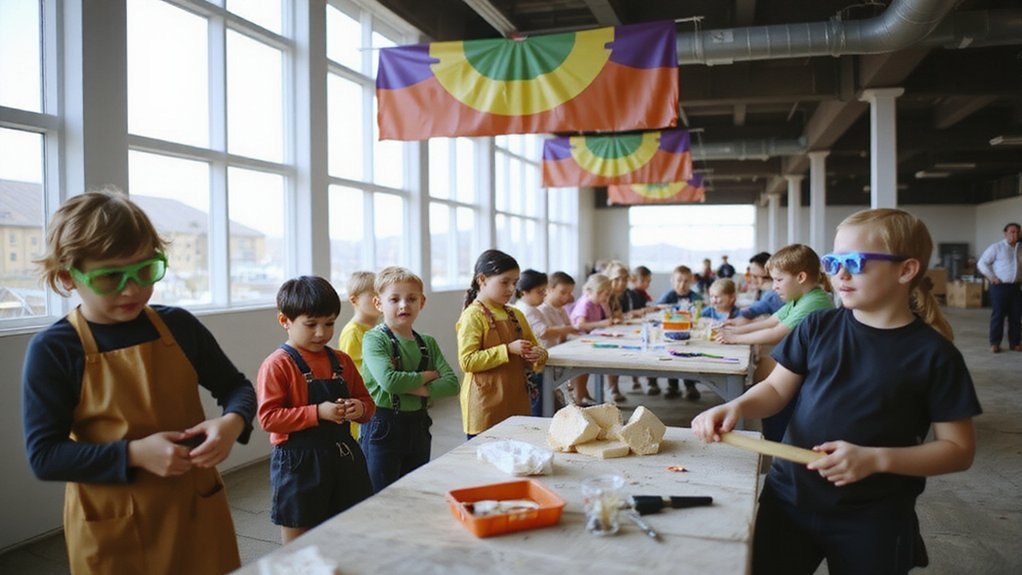
How would you turn an idea into something that works? In the museum lab you’ll pick a problem, sketch solutions, and gather simple materials—straws, tape, rubber bands, cardboard. You’ll build prototypes fast, test them, and watch what fails. Failure’s good: you’ll learn how to improve strength, balance, and motion. Measure results, change one thing at a time, and test again. Challenge friends to build the tallest tower, the strongest bridge, or the fastest vehicle using your design rules. Record your steps, draw what changed, and celebrate clever fixes. You’ll sharpen creativity, teamwork, and engineering thinking while making real inventions from playful experiments that spark future innovation. Bring curiosity, ask questions, and iterate until your prototype meets the goal or surprises you — then try again.
Interactive Earth Science Activities
Earth science comes alive as you touch rocks, stir soil, and model volcanoes with simple materials. You’ll investigate layers by building clear sediment columns, observe erosion with water and sand, and test soil drainage for plant growth. Use handheld tools, magnifiers, and simple sensors to measure pH, temperature, and moisture. Map local rock types, sketch contours, and predict where water will flow after rain. Create a fossil dig box to uncover replica bones and learn stratigraphy through play. Try making rain in a jar to see cloud formation and precipitation cycles. Every activity encourages hypotheses, quick experiments, and creative solutions, so you innovate while learning real Earth processes in a safe, supervised museum setting. You’ll leave curious, equipped to explore the planet further today.
Mini Makerspace Projects for Creative Problem Solving
When you step into a mini makerspace, you’ll find hands-on projects that turn curiosity into quick designs and smart solutions. You’ll build simple circuits with snap components, prototype cardboard robots, and sketch inventions with markers and rulers. Small challenges—make a bridge that holds a toy car or design a launcher that tosses a pom-pom—teach iteration: test, tweak, and try again. You’ll use safe tools, collaborate with friends, and document ideas on sticky notes or tablets. Facilitators guide questions so you learn why things work, not just how. These projects boost creativity, engineering thinking, and confidence, and they encourage you to imagine better tools and games. Every mini project sparks the mindset of a maker ready to solve real problems. Keep experimenting and sharing discoveries.
Water Play Experiments: Buoyancy and Flow
Why does a rubber duck bob while a pebble drops? You can explore buoyancy by testing objects in water and measuring how much they displace. Try filling tubs, predict which items float, then modify them—add clay, cut holes, reshape—to innovate better floaters or sinkers. Watch how water flow changes with slopes: build channels from gutter pieces or cardboard, vary steepness, and time how fast toy boats travel. Record results, sketch designs, and redesign to improve speed or stability. You’ll learn about density, displacement, and streamlined shapes through playful experiments that encourage curiosity and iteration. These hands-on activities spark problem-solving and creative engineering thinking, giving you simple tools to test bold new ideas. Invite friends to collaborate and compare results, accelerating learning through shared discovery.
Light and Optics Explorations for Curious Eyes
Just like you experimented with shapes and slopes in water, you can play with light to see how it bends, bounces, and makes colors. Grab a flashlight, mirror, and a glass of water to explore reflection, refraction, and dispersion. Tilt the mirror to aim beams, watch how light changes direction on shiny surfaces, and put the glass in the beam to see the spot shift. Use a CD or prism to split white light into rainbow bands; notice patterns and predict angles. Set up shadow puppets to study how opaque, translucent, and transparent materials affect intensity and shape. Record observations, adjust variables, and invent new setups. These hands-on experiments teach optics principles and spark creative problem-solving you can build on. You’ll amaze your friends.
Biology Basics: Plants, Insects, and Animal Habits
How do plants, insects, and animals fit together in the world around you? You can explore food webs by watching a single patch of garden: seeds become leaves, leaves feed caterpillars, caterpillars become butterflies that pollinate flowers. You’ll notice behaviors—birds building nests, ants farming aphids, bees communicating with dances—and those habits keep ecosystems balanced. Try simple experiments: track plant growth under different lights, map insect trails with safe bait, or record animal activity with a notebook. You’ll make hypotheses, test them, and tweak ideas like a junior scientist. These projects teach adaptation, cooperation, and cause-and-effect. They spark curiosity and invite innovation: you might invent better habitats, citizen-science tools, or kid-sized monitoring systems that help nature thrive. Share results and learn from each other’s designs.
Sensory Science Stations for Early Learners
After watching gardens and critters, you can bring nature’s clues to the table with sensory science stations made for little hands. Set up bins with sand, water, leaves, pinecones, and safe tools so kids explore textures, buoyancy, and scent. Label stations with simple prompts — “What sinks?” or “Which smells like lemon?” — to spark questions and predictions. Rotate materials weekly to keep curiosity fresh and introduce new vocabulary: absorbent, squishy, rough, buoyant. Guide observations with open-ended prompts and short experiments that show cause and effect. Use magnifiers, measuring cups, and scales to add discovery-driven tech. You’ll foster investigation, fine motor skills, and scientific language while giving children playful, hands-on ways to test ideas and invent solutions. Share results with families to inspire at-home exploration together.
Conclusion
You’ll leave Discovery Children’s Museum excited to try these kid-friendly experiments at home. You’ll mix safe chemistry, test ramps and float objects, build simple machines, and explore plants and bugs while measuring, guessing, and trying again. Facilitators help you learn science words and use tools, and family teamwork makes it more fun. Keep a notebook, repeat favorites, and share discoveries with friends — you’ll spark curiosity and keep wondering about the world every single day.
Leave a Comment